Your Story Isn't Finished: How America's Best Creators Keep Rewriting the Chapter They're Living In
Your Story Isn't Finished: How America's Best Creators Keep Rewriting the Chapter They're Living In
There's a myth that follows successful creators around like a shadow: the idea that they had it figured out from the start. That somewhere between the first YouTube video or the debut novel or the scrappy indie film, there was a fully formed vision — a clear, consistent identity that never wavered.
That's almost never true.
What's actually happening behind the scenes is something far more interesting, and honestly, more useful for the rest of us. The creators who endure — the ones who stay relevant, stay hungry, and keep making work that actually lands — treat their own life story not as a fixed biography, but as something closer to a living document. A draft that's always one revision away from being more honest, more precise, more them.
The Psychology of Who You Think You Are
Psychologists have a term for this: narrative identity. The basic idea is that human beings don't just experience their lives — they construct them. We take the raw material of memory, emotion, and experience and shape it into a story with arcs, themes, and meaning. The problem is that most of us write that story once, early on, and then spend decades defending it.
Think about how many people you know who are still living inside a version of themselves that was written at 22. The identity they built around a particular city, a particular relationship, a particular failure or success — and they've been holding onto that draft ever since, even when the evidence suggests it's time for a rewrite.
Creators who break through tend to be the ones who figure out — sometimes painfully — that clinging to an outdated self-narrative doesn't make you consistent. It makes you stuck.
Revision as Courage, Not Contradiction
Here's where it gets interesting. A lot of people resist updating their story because it feels like a betrayal — like admitting they were wrong, or worse, like being inauthentic. But think about how you'd respond to a novelist who refused to revise their manuscript. You'd probably tell them that's not integrity. That's fear.
The same logic applies to your personal narrative.
Take someone like Issa Rae. Before Insecure became a cultural touchstone on HBO, she spent years building an audience through The Misadventures of Awkward Black Girl on YouTube. That early chapter was real, it was authentic, and it was also a rough draft. She didn't abandon it — she revised it. She took what was true and sharpened it, expanded it, and brought it to a bigger stage without pretending the earlier version never existed.
Or consider how many podcasters and journalists have publicly reckoned with positions they held five or ten years ago — not to perform humility, but because they genuinely evolved. The ones who do it well don't erase the old chapter. They contextualize it. They show the seam between who they were and who they're becoming, and somehow that seam becomes the most compelling part of the story.
The Audit: Reading Your Own Draft With Fresh Eyes
So how do you actually do this? How do you look at your own story with the same editorial distance you'd bring to someone else's work?
Start by asking a few uncomfortable questions:
What's the founding myth you're still carrying? Every creator has one — a story about where they came from or what they survived that became the cornerstone of their identity. Is that story still accurate? Is it still serving you, or has it calcified into something that limits what you think you're allowed to do next?
Which chapters are you skipping over? The stories we don't tell are just as revealing as the ones we do. If there's a period of your life or career you consistently gloss over in interviews or in your own head, that's usually worth examining. Sometimes those are the chapters that contain the most usable material.
Who wrote the version of you that you're currently presenting? Was it you — deliberately, with intention — or did it get written by circumstance, by other people's expectations, by an industry that needed you to fit a particular box? If someone else drafted that version of your identity, you have every right to revise it.
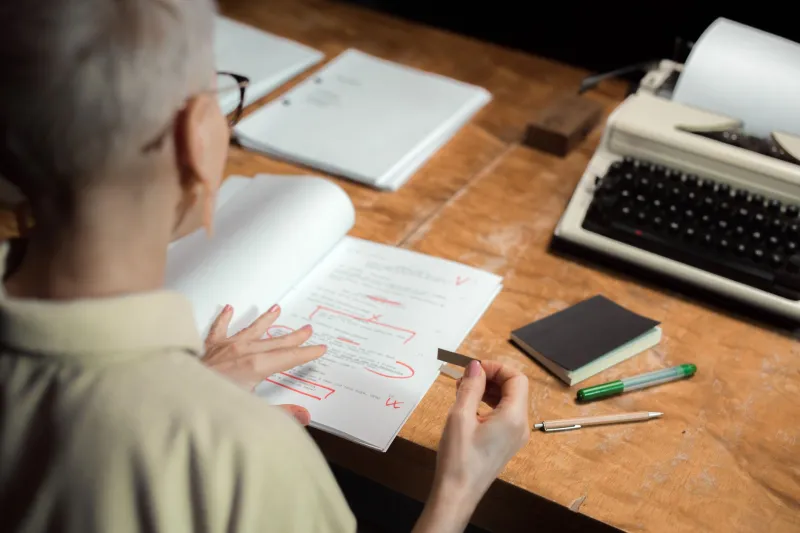
What would you cut if this were a manuscript? Not everything that happened to you belongs in the story you're telling publicly. Good editing isn't dishonesty — it's clarity. Deciding what to leave out is as important as deciding what to keep in.
The Living Document in Practice
The practical application of all this isn't about navel-gazing. It's about creative output. When you treat your own story as something that's still being written, you give yourself permission to take creative risks that a fixed identity wouldn't allow.
Filmmakers who've been pigeonholed in one genre start experimenting with another. Novelists who built an audience on one kind of book take a sharp left turn — and their readers follow, because the evolution feels earned rather than random. Podcasters pivot their entire premise because they've genuinely grown past the version of themselves that started the show.
The key in all of these cases is transparency. You don't just change — you bring your audience along for the revision process. You let them see the draft. That's not oversharing. That's the kind of authentic storytelling that builds genuine loyalty in an attention economy that's absolutely saturated with performed certainty.
Before Your Next Project Goes Public
If you're sitting on a creative project right now — a book proposal, a series pitch, a new podcast, a rebrand — this is the moment to do the audit. Before you go public with the next version of your work, make sure you've done the internal revision first.
Because here's the thing: audiences can tell when a creator is still living inside an old draft of themselves. There's a flatness to it, a slight disconnect between the story being told and the person telling it. And they can equally tell when someone is operating from a place of genuine, updated self-knowledge. That version is magnetic. That version is the one people bookmark, subscribe to, and come back for.
Your story isn't finished. It was never supposed to be. The most honest thing you can do — for your audience and for your own creative life — is keep writing it.
Open the document. Start the revision. See what's actually there.